
Why Does My Doodle Keep Matting? A Spring Hill Grooming Guide
TL; DR
Doodles mat when their coat type doesn’t match their grooming routine. Curly and combination coats tangle fastest and are the least forgiving; straight and double coats give you more wiggle room. The three habits that prevent the vast majority of mats: brush all the way down to the skin using line brushing, run a quick comb check between grooms, and always dry the coat completely after any bath or swim.
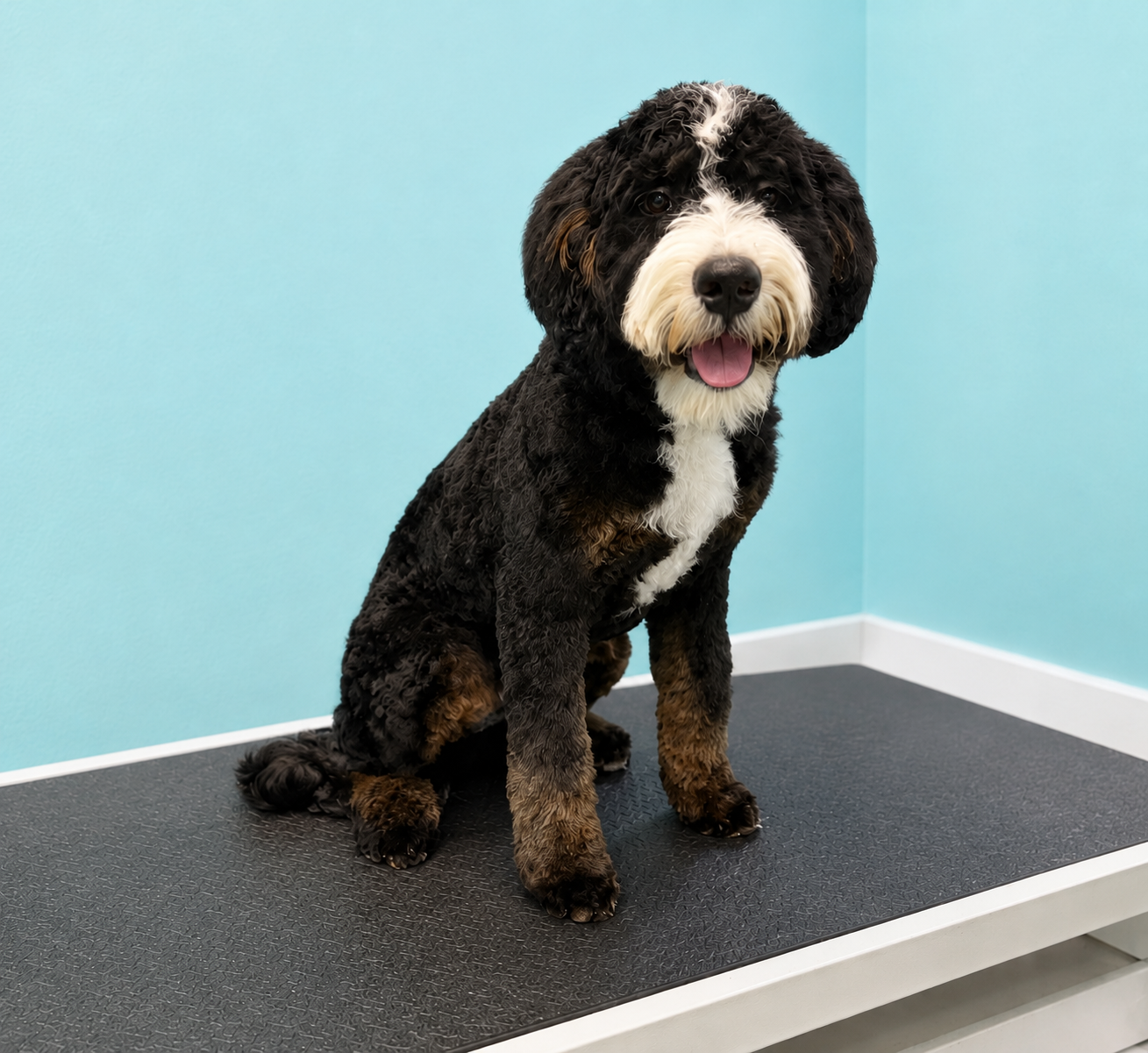
If you own a doodle in SpringHill — a Goldendoodle, Labradoodle, Bernedoodle, or any of the many doodle mixes — you have probably had this moment: your pup looks perfectly fluffy on Monday, and by the weekend the groomer is gently telling you there are mats hiding under all that hair. It is one of the most common and most frustrating experiences for doodle parents — and the good news is that it is almost entirely preventable. At Pooch Playhouse and Boarding, our Spring Hill dog grooming team works with doodles of every shape and size, and we want to demystify exactly why doodles mat and what you can do at home to stop it.
The short answer is that doodles come in a wide range of shapes, sizes, and hair textures, and most matting traces back to a mismatch between a dog’s coat type and the maintenance routine it is actually getting. Understand your doodle’s coat, build the right home routine around it, and you will transform grooming day for both of you.
First, Figure Out Your Doodle’s Coat Type
Before you can prevent matting, you need to know what kind of coat you are working with. Doodles have one off our coat textures, and each one mats at a different pace:
• Curly: Tight, springy curls — the highest-maintenance coat and the quickest to tangle.
• Combination: Part curl, part wave. Mats nearly as fast as a fully curly coat.
• Straight: A smoother, flatter coat that is much more forgiving if you miss a brushing.
• Double Coated: A soft topcoat over a dense undercoat, generally lower on the maintenance scale.
This is the heart of the matting question. Curly and combination coats have a much higher risk of matting and need a more consistent grooming and maintenance schedule, while straight and double coats can go longer between grooms. And here is the part that surprises people: curly and combination coats are extremely unforgiving once matting starts. A tangle that goes unnoticed for a few days can spread across the whole body — which is exactly why so many doodles “suddenly” seem to mat overnight.
The Three Tools That Prevent Most Doodle Matting
Preventing mats at home does not require fancy equipment. Three tools do the vast majority of the work:
• A greyhound comb with a wide-tooth and a fine-tooth side — the tool that tells you whether hidden tangles are forming.
• A slicker brush with long, dense, curved metal pins —the brush that actually removes tangles and keeps mats from setting in.
• A detangling and conditioning spray — essential, because brushing a dry coat causes breakage and discomfort.
Pick products that fit your lifestyle, your routine, and your dog’s coat type. When the tools match the dog, home maintenance becomes quick and painless instead of a weekly struggle.
How to Catch Doodle Matting Before It Spreads
The reason mats sneak up on doodle parents is that they form down near the skin, out of sight beneath a coat that still looks full. Two quick checks will tell you what is really happening:
The Comb Test
Run your greyhound comb through the coat over your pup’s entire body. If it passes through cleanly, you are tangle-free. If the comb will not glide through, tangles are present and it is time to brush them out.
The Dryer Test
Blow the hair apart using ahigh-velocity pet dryer, or a regular hair dryer on a cool setting. If you can see the skin and the hair is straight and smooth, there is no matting. If all you see is more hair with no skin showing, the coat is matted and needs to be worked through right away.
Line Brushing: The Anti-Matting Secret
Most matting happens because of how people brush, not how often. Brushing only the surface leaves the coat near the skin untouched — and that is exactly where mats form. The fix is a technique called line brushing, and learning it is the most powerful thing you can do to keep your doodle mat-free. Here is how:
1. Mist your detangling spray over the section you are about to brush. Never brush a dry, tangled coat.
2. Start at the lowest part of the area. Use your freehand to push the hair upward, creating a line that exposes the skin.
3. With your slicker brush, brush downward in the direction the hair grows, pulling a little hair out from under your hand with each pass.
4. Continue up the area one line at a time until the whole section has been brushed from the skin out.
5. Check your work by running the greyhound comb through parallel to the body. If it glides, move on; if it catches, go back to the slicker and repeat until it is smooth.
Keep the brush moving around the body instead of staying on one spot, which can irritate the skin. It feels slow at first, but once line brushing becomes a habit it is fast and even relaxing —and it is the single biggest reason some doodles never need to be shaved down while others do.
The Five Hot Spots for Doodle Mats
Mats do not form evenly — they concentrate in high-friction areas where the coat rubs against itself, a collar, or a harness. On most doodles, the usual suspects are:
• Behind and around the ears
• The muzzle and beard
• The armpits and chest friction zones
• Between the toes and around the paws
• The tail
These areas mat the most, so give them extra attention every time you brush. A couple of focused minutes on these spots prevents the tight, painful mats that are hardest to remove.
The Drying Mistake That Causes Matting
Many Spring Hill doodles love water — the splash pad, the lake, a backyard kiddie pool, a surprise Tennessee rainstorm. The activity is fine; the mistake is letting the coat air dry. When a curly coat gets wet and dries on its own, the hair shrinks and curls tightly around itself, locking any small tangles into dense mats — and if matting is already present, air drying makes it much worse.
Takeaway: After any bath or swim, always dry your dog completely. This one habit prevents a huge share of the matting we see.
Setting a Grooming Schedule That Actually Sticks
There is no universal grooming frequency for doodles, which means you get to build a schedule around your real life. As you plan, factor in your dog’s coat type, how long you keep the coat, how much home maintenance you want to take on, and the lifestyle you and your pup live.
Two common styles bracket the range:
• Long, fluffy “teddy bear” trims: require daily home brushing along with regular professional baths and brush-outs at the groomer.
• Short, sporty clips: can go up to eight weeks between professional grooms with lighter home maintenance.
Neither is better — the right choice is the one you will keep up with. This is a great conversation to have with your groomer so we can set up a plan that fits you and your pup perfectly.
Why Consistency Makes Everything Easier
A regularly groomed dog is a happy dog. Sticking to a steady schedule also lets your doodle build a relationship with their groomer, which greatly reduces the stress of the grooming process.
Takeaway: Over time, that familiarity turns grooming day from something to dread into just another comfortable part of your pup’s routine.
The Great Doodle Coat Change
Here is something many first-time doodle parents do not see coming: somewhere between roughly eight months and a year and a half of age, most doodles go through a “coat change” as their soft puppy fur is replaced by their thicker adult coat. During this transition, the two coats tangle together and doodles mat far more easily than usual —sometimes seemingly overnight, even with a normal routine. If your once-easy puppy suddenly seems to mat constantly, the coat change is very often the reason. The solution is to temporarily step up your brushing during this window and lean on line brushing. Many parents also choose a shorter cut to ride out the transition more comfortably. It does pass — and on the other side you will know exactly what kind of adult coat you are working with.
Mat vs. Tangle: What’s the Difference?
Not every knot is a crisis. The reason early detection matters so much is that today’s easy tangle becomes next week’s stubborn mat if it is ignored — which is the whole point of regular comb checks.
What it is & what to do:
Tangle - A loose snarl of hair that a slicker brush and detangling spray can work through fairly easily. Catch it now with a comb check.
Mat - A tangle that has tightened into a dense, felted clump close to the skin that no longer brushes out. Tight mats against the skin are safest handled by a professional groomer.
Doodle Matting FAQ
How often should I groom my doodle?
It depends on coat type and the length you keep. Long, fluffy coats need daily home brushing plus regular groomer visits, while a shorter cut can stretch up to eight weeks between grooms. Build the schedule around your doodle’s coat type, the length you want, and how much home maintenance you’ll realistically keep up with.
Why is my doodle suddenly matting overnight?
The two most common reasons are the coat change between about eight and eighteen months of age, and letting the coat air dry after a bath or swim. Surface-only brushing that never reaches the skin is a close third. Goldendoodles and other curly-coated doodles are especially prone to this.
What’s the difference between a mat and a tangle?
A tangle is a loose snarl that brushes out with a slicker brush and detangling spray. A mat is a tangle that has tightened into a dense, felted clump near the skin that no longer brushes out and often needs a professional groomer.
What tools do I need to prevent doodle matting?
Three: a greyhound comb to detect hidden tangles, a slicker brush to remove them, and a detangling and conditioning spray so you never brush a dry coat.
Where do doodles mat the most?
In high-friction spots: around the ears, the muzzle, the armpits, between the toes, and the tail. Give these areas extra attention every time you brush.
Can I cut a mat out at home?
It’s risky — mats sit tight against the skin and it’s easy to nick your dog with scissors. Tight or widespread mats are safest handled by a professional groomer.
Do you groom doodles in Spring Hill?
Yes. The Pooch Playhouse grooming team in Spring Hill grooms doodles of every coat type, identifies your pup’s coat, and builds a maintenance plan that fits your lifestyle.
Keep Your Doodle Mat-Free at Pooch Playhouse in Spring Hill
If your doodle keeps matting —or you simply want to stay ahead of it — the grooming team at Pooch Playhouse in Spring Hill is here to help. We will identify your pup’s coat type, build a maintenance schedule that fits your lifestyle, and keep that doodle coat soft, healthy, and tangle-free.
Say goodbye to surprise mats. Call Pooch Playhouse in Spring Hill or book your doodle’s grooming appointment online today.
Stay updated with our latest news, tips, and special offers for your furry friend!
Explore Our Latest Posts
Stay updated with our latest news, tips, and special offers for your furry friend!
Stay in the Loop!
Sign up for our newsletter to receive updates, special offers, and dog care tips. Be the first to know about exclusive promotions and new services for your furry friend!
